Short answer
Select the reader for a controlled read zone
The important result is not a record distance. It is consistent reading of the target tags at the operating speed without unwanted events from adjacent zones.
The reader, antennas, cables, tags, installation and software filtering form one system. A single device specification does not describe the result of the full operation.
Hardware classes
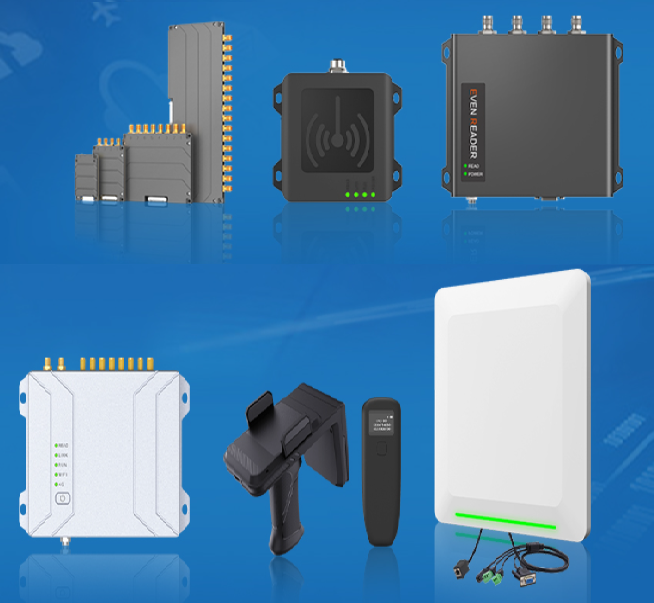
Four types of UHF RFID readers
The device type defines how it works; the zone and process determine the final configuration.
Multi-port reader
Connects several external antennas. Used at gates, conveyors and zones that require separate coverage geometry.
Integrated reader
Combines the reader and antenna in one enclosure. Simplifies installation at checkpoints and local passages.
Desktop reader
Registers, encodes and verifies tags in a small controlled zone without capturing nearby items.
Handheld terminal
Used for stocktaking, tag search and walk-throughs. The application, battery life, ergonomics and API all matter.
Sequence
Five steps from the process to the specification
This order prevents a real task from turning into a list of maximum catalog values.
Object
Product, pallet, asset, tool, vehicle or textile.
Movement
Speed, direction, grouping and tag orientation.
Zone
Target and adjacent objects, dimensions and mounting points.
Event
Passage, receiving, shipping, inventory or vehicle entry.
Pilot
On-site measurements and approval of the final configuration.
Antennas
Polarization, radiation pattern and installation define the geometry
The same reader can perform differently with different antennas, cables and tag orientations.
Linear polarization
Can provide a more focused result when tag orientation relative to the antenna is consistent.
Circular polarization
Usually more practical when tags pass through the zone at different angles.
Radiation pattern
A narrow pattern helps separate a zone; a wide pattern covers more space.
Cable and mounting
Cable length and type, connectors, bends and outdoor exposure affect loss and maintenance.
Specification
Which characteristics actually matter
The checklist connects RF performance, industrial installation and integration.
- Regional profile. Frequencies and power limits for the country of operation.
- Air interface. EPC Gen2 / ISO/IEC 18000-63 and the required operating modes.
- Antenna ports. Quantity, independent settings and polling sequence.
- RF parameters. Power control, sensitivity and operation in a dense RF environment.
- Interfaces. Ethernet, Wi-Fi, serial port, GPIO and power.
- Management. LLRP, SDK, logging, monitoring and firmware updates.
- Enclosure. Temperature, moisture, dust and service access.
Maximum power does not create the best read zone
Excess power can add adjacent tags, reflections and interference. Configure the level that consistently covers the target operation and confirm the zone boundaries by measurement.
Practical configurations
The hardware changes with the scenario
These are starting architectures for a site survey and test, not ready-made kits.
Gate
Fixed reader, several antennas, passage trigger and direction logic.
Stocktaking
Handheld terminal, application, bulk reading, tag search and result export.
Encoding
Desktop reader or RFID printer with a localized zone and write verification.
Vehicles and checkpoint
Integrated or fixed reader, directional zone, controller and triggers.
Conveyor
Fixed read point, object sensor and settings for speed and spacing between items.
Business event
Middleware removes duplicates and sends a meaningful operation to 1C/WMS instead of a raw read stream.
Before ordering
Project specification checklist
These items should be known before purchasing the complete hardware set.
- Zone layout
Dimensions, movement direction, adjacent objects and mounting points.
- Representative samples
Products, packaging, surfaces and several suitable tag candidates.
- RF configuration
Regional profile, antennas, cables, power and polling sequence.
- Infrastructure
Network, power, GPIO, industrial automation and failure scenarios.
- Software layer
LLRP or SDK, duplicate filtering, event log and integration with the business system.
- Acceptance method
Test conditions, measurable criteria and a control verification method.
FAQ
Selecting an RFID reader without catalog traps
How many antenna ports does a reader need?
As many as are required for controlled coverage of the working zone, considering geometry, movement and adjacent objects. Determine the number from the layout and test, not only from the gate width.
Is linear or circular polarization better?
Linear polarization can localize reads when tag orientation is predictable. Circular polarization is usually more practical with random orientation. Confirm the final choice on actual objects.
Should the reader always use maximum power?
No. Excess power can add unwanted reads, reflections and interference. Use the level that consistently covers the target operation.
How is a fixed reader different from a handheld terminal?
A fixed reader operates automatically in a defined zone and connects to sensors and automation. A handheld moves with the operator and suits stocktaking, walk-throughs and tag search.
Is LLRP required?
LLRP provides a standardized low-level interface for compatible readers. If a device does not support it, use the manufacturer SDK. A separate software layer still turns reads into business events.
Can hardware be selected without a pilot?
Catalog shortlisting is possible, but a project specification should be confirmed on representative objects, in the actual zone and at the operating speed.
Editorial review: 16 July 2026.
Sources: RAIN Alliance field guide, RAIN reader interface, GS1 LLRP, ETSI EN 302 208.
Next step
We will configure one working read zone
Send the area layout, representative objects and an operation description. BizData will propose a test setup and validate the hardware configuration.
